'It's real television': The Junk & Disorderly guys gear up for a brand-new series
There’s a moment in Junk & Disorderly that perfectly captures why the show has become one of British television’s quiet triumphs. A bike coughs into life after decades of silence. Then the exhaust falls off, while someone disappears into a hedge. Everyone laughs, but no one edits it out.
In the current climate of polished presenters, scripted “reality” and glossy restorations that bear little resemblance to real life, Junk & Disorderly remains gloriously and unapologetically itself. The show has an enduring appeal that comes down to three things: honesty, friendship and the simple pleasure of bringing old things back to life.
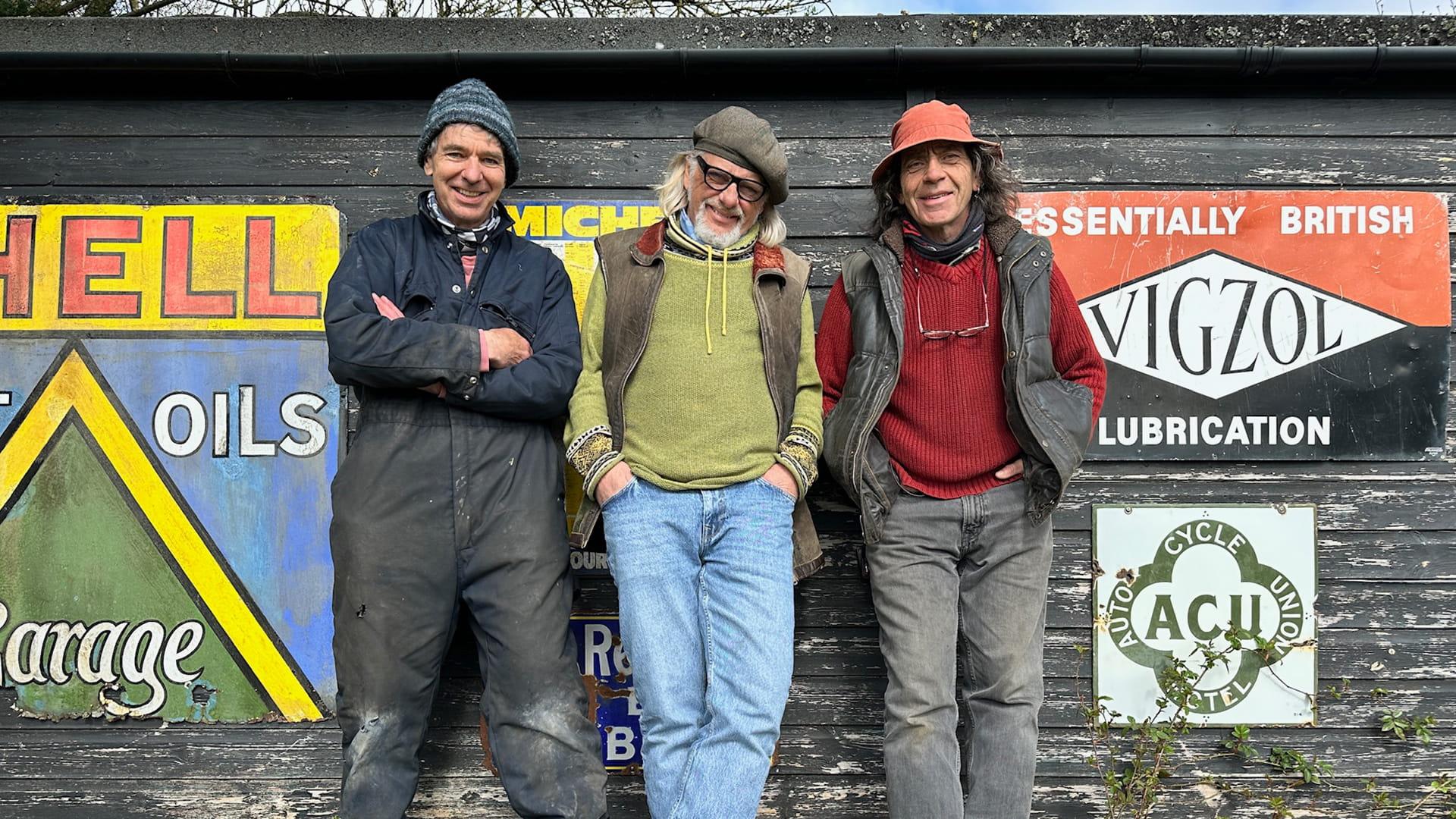
At the heart of it all are Henry Cole, Guy ‘Skid’ Willison and Allen Millyard – three men who insist they’re not performing for the camera, because frankly, they wouldn’t know how to.
The new series of Junk & Disorderly airs Tuesday at 3pm and 9pm, exclusively on BLAZE, so we caught up with the three men who continue to entertain.
‘It’s just us three old men messing about’
In many ways, Junk & Disorderly is a quiet antidote to modern television. It takes its time, doesn’t pretend to be perfect and finds humour in things going wrong. The show reminds us that not everything has to be fast, flashy or expensive to be worthwhile – sometimes it’s enough to share a laugh, get your hands dirty and bring something old back to life.
Its success was never part of any grand plan. According to Henry Cole, if anything, it filled a gap that modern television had forgotten was there.
‘There is a certain audience that’s been neglected,’ he says. ‘With Junk & Disorderly, what we’ve inadvertently done is create an opportunity for that niche to be filled.’
When viewers tell him the show reminds them of Last of the Summer Wine, Henry is delighted. ‘That’s a fantastic compliment,’ he says. ‘It shows people are connecting with us.’
The comparison to Summer Wine comes up again and again – a similar gentle, mischievous energy and a sense that nothing terribly bad is going to happen. Not to mention, the comforting knowledge that even when it all goes wrong, it will probably be funny. Guy Willison agrees wholeheartedly.
‘There’s that mischievous but harmless edge to it,’ he says. ‘A lot of people can relate to it because we're just three old gits in a shed, and we work on stuff that's achievable for them.’
And that’s the key. There are no Bugattis, no six-figure restorations completed by teams of unseen experts. If viewers want to have a go themselves, they can.
‘Most people can go out and buy a cheap classic bike or car and do it up,’ Guy says, ‘Or they can go to an auto jumble and buy a few trinkets and polish them. So I think people can identify with that.’
No scripts, no second takes, no pretending
If you ask any of the trio what separates Junk & Disorderly from other restoration shows, you’ll get the same answer: there’s no script.
‘Never,’ Henry says emphatically. ‘There’s never been a script ever.’
When people ask who writes the dialogue, Guy’s answer is simple: ‘If you asked me to act, I’d be hopeless. I’m not an actor. I’m me.’
Allen Millyard, the quiet genius of the group, agrees. ‘There are no meetings, no discussions beforehand,’ he says. ‘We just turn up and shoot. It all starts with a cup of tea and a bit of mickey-taking.’
The genuine atmosphere of the show extends to the mistakes, which are probably the most beloved part of the programme.
‘If there’s a mistake, we leave it in,’ Guy says. ‘That’s real life.’
Henry talks about one mistake that still makes him wince. A helicopter restoration went catastrophically wrong when a plastic bubble windscreen cracked straight across.
‘That was the last time I was speechless,’ he says. ‘It cost me 20,000 quid for a new bubble, and it wasn't insured.’
Those “oops” moments aren’t ignored or edited out. In fact, they’re central to the show’s charm. Viewers don’t just see the success, they see frustration, annoyance and the occasional panic when everything falls apart.
‘But,’ Henry adds, ‘they make the days where it goes right all the more satisfying.’
Three mates – not a manufactured ‘team’
The chemistry between the three friends can’t be manufactured. It has to exist long before the cameras arrive. Guy and Henry have known each other for 45 years and Allen fitted into the dynamic naturally, despite describing himself as ‘quite a quiet person’.
‘We’re all mates,’ Allen says simply. ‘That’s not made up. We’d do anything for each other.’
Their close friendship naturally leads to the relentless ribbing viewers love so much. Allen and Guy delight in pointing out Henry’s flaws – his hair, his potbelly, his habit of buying bikes that are ‘good from far and far from good’.
And Henry doesn’t deny it.
‘He brings them here and says, “I’ve got this lovely bike,”’ Allen laughs. ‘And I have to tell him, “It’s actually quite bad. Did you check it starts? It’s got no engine in it at all.”’
On occasion, Henry arrives with nothing more than a chassis and a Tesco carrier bag full of engine parts.
‘He’ll say, “Oh, you can get that going.”’ Allen explains. ‘And of course, I did get it going in half an hour. But he doesn’t make things easy!’

Allen Millyard: the quiet wizard
If Henry is the wheeler-dealer and Guy the talker, Allen Millyard is the man who calmly brings the dead back to life.
‘The worse an engine is,’ Allen says, ‘the more I want to restore it.’
He once revived a Spitfire auxiliary power unit that hadn’t run since 1948. Not to mention for Junk & Disorderly, he’s tackled everything from seized 1920s engines to machines converted into tractors in the 1930s.
One of the show’s funniest moments came when Henry and Guy proudly returned with a Triumph chopper they’d paid good money for.
‘I touched the engine and it fell off,’ Allen recalls. ‘I touched the exhaust and it fell off.’
After hours of work, Allen got it running but then discovered that the steering was locked. He went straight through a hedge into stinging nettles.
‘I allowed it to be used,’ he says, ‘because it shows it’s real television.’
That’s Allen in a nutshell: astonishing skill, zero ego and a willingness to laugh at himself.
The shed as sanctuary
Beyond the laughter and mechanical chaos, Junk & Disorderly taps into something deeper – the shed as a place of refuge.
‘There’s something very relaxing about it,’ Henry says. ‘When you focus on your work there, you can’t think about anything else.’
Guy describes his workshop as a sanctuary. ‘I'm in my own world. I don't think about the outside world when I'm there. I'm not thinking about politics or wondering how I am going to make that payment this month. I'm just doing what I'm doing, and I'm never happier.’
Allen agrees. ‘A shed has a particular atmosphere,’ he says. ‘There's a specific smell. You’ve got the engine, the bikes, the creosote and the engine oil. People can escape from reality in a shed.’
For all three men, restoration isn’t just practical – it’s good for the mind too.
Henry says, ‘Even if you've just painted a foot peg with a rattle can, you still think, “That looks really good.’"
Why women are tuning in too
While it used to be seen as a male-dominated space, Junk & Disorderly has quietly built a large and growing female audience, which all three men are delighted by.
‘Now it's crossed over and the wives watch as well.’ Guy says.
Henry has noticed this on filming days. ‘About 40% of the people who come up to us are women,’ he says. ‘“Oh, I did hate you, but actually when I watched Junk & Disorderly, I really enjoyed it.”’
The reason is simple: the show isn’t really about engines.
‘Entertainment is entertainment,’ Guy says. ‘Women like banter as well. The fact that it is between three men doesn't matter. If I do a sharp one-liner cutting Henry down, they'll appreciate it as much as the men.’
Allen adds that many fans openly admit they have no interest in mechanics at all. ‘They just love the show,’ he says. ‘People find it so relaxing to watch, and that’s great.’
Saving history – and leaving a legacy
Henry believes that restoration goes beyond profit or even enjoyment. It’s significant because it’s about preserving British engineering heritage.
‘I want to save elements of that for future generations,’ he says. ‘You’re leaving a legacy.’
That preservation philosophy runs through every episode. Whether it’s a rare set of vintage oil bottles or a bike worth £50, the joy comes from saving something that might otherwise disappear.
‘We always say, “We’ve saved another,”’ Henry says. ‘That’s so rewarding.’
But what if they lose money?
‘You haven’t really lost,’ Allen says. ‘You’ve bought enjoyment – and that’s priceless.’
Why Junk & Disorderly matters
Ask viewers why they watch Junk & Disorderly and the answers are all the same. It relaxes them. It cheers them up. It feels like sitting in the corner of a shed with friends.
‘One guy told me he comes home stressed from work, puts his feet up and watches it,’ Allen says. ‘People find it comforting.’
In a noisy, chaotic world, that simplicity is powerful.
As the new series launches on 3rd February, Junk & Disorderly remains exactly what it has always been: three mates, no script, a kettle on the boil and the quiet satisfaction of making something work again.
Or as Henry puts it, with typical honesty: ‘It works because it is what it is – and it’s completely honest.’
And that, perhaps, is why audiences keep coming back.
Find out why Junk & Disorderly continues to charm audiences with its warmth, wit and wonderfully honest restorations when the brand-new series returns. Tune in Tuesdays at 3pm and 9pm for more laughs, banter and brilliant shed-based escapism.